
Suburb in Focus: Launceston, Tasmania
Launceston at a Glance
- Location: Northern Tasmania
- Distance to Hobart: Approx. 200km via Midland Highway
- Median House Price: $750,000
- 12-Month Growth: 0.5%
- Average Annual Growth (5 Years): +5.6% p.a.
- Rental Vacancy Rate: 1.6% (houses), 1.69% (units)
- Median Rental Yield: 3.7%
- Median Days on Market: 37 days (houses), 72 days (units)
- Annual House Sales: 75 Sold
- Key Buyer Demographic: Established families, upsizers, professionals, long-term owner-occupiers
- Primary Appeal: Premium North Brisbane Location + Leafy Estate Character + Strong Capital Growth
Source: PropTrack data as at 2025
Why Launceston Is One of Australia’s Most Compelling Regional Investment Stories in 2026
Launceston is not competing for national attention. But the data and the structural investment being directed at this city suggests it deserves considerably more of it.
Hotspotting named Launceston in its National Top 10 Best Buys report for 2026, placing it alongside Inner Brisbane, the Sunshine Coast, and Greater Hobart as markets identified as earlier in their growth cycle with the fundamentals in place to deliver sustained long-term returns. The rental vacancy rate sits below 1% city-wide, rental yields average 4.7%, and a $304 million UTAS campus relocation to the Inveresk precinct has fundamentally transformed the relationship between the university and Launceston’s CBD with a target of 10,000 students engaged on campus by 2032.
At a median dwelling value of $581,091, Launceston represents one of the most affordable entry points of any Australian city with genuine capital growth credentials. For buyers who understand the difference between a market that has already run and a market that is structurally building toward its next phase, Launceston in 2026 is a market worth taking seriously.
For broader insights into the region, explore our Brisbane Buyers Agent services.
Where is Launceston?
Launceston is Tasmania’s second-largest city and the commercial and civic capital of northern Tasmania, positioned approximately:
- 200 kilometres north of Hobart via the Midland Highway,
- at the convergence of the Tamar, North Esk, and South Esk rivers, a geography that defines much of the city’s character, its wine and tourism economy, and its lifestyle appeal,
- and approximately 60 kilometres from Launceston Airport, which offers direct services to Melbourne, Sydney, and Brisbane.
The broader Launceston market encompasses multiple distinct suburbs with meaningfully different price points and characteristics:
- East Launceston the premium suburb, median house $925,000, 3.35% annual growth, 3.66% yield,
- Trevallyn tightly held, approximately $802,000 median, 12.8% annual growth, 3.57% yield, 2.03 months inventory,
- South Launceston strong momentum, median $609,125, 12.28% annual growth, 4.90% yield, 20 days on market,
- West Launceston high volume, median $630,000, 0.80% annual growth, 77 house sales per year,
- Prospect family suburb, approximately $698,000 median, 3.9% yield, vacancy 0.68%, inventory 0.84 months,
- and Launceston CBD/7250 the postcode-level market with a median of approximately $684,000 and the lowest recent 12-month price growth of any suburb, reflecting its more mixed dwelling composition.
This diversity is central to the Launceston investment case: different suburbs are at different stages of their own cycles, and the strongest near-term data comes from South Launceston and Trevallyn rather than the postcode as a whole.
Launceston is serviced by:
- Launceston Airport direct flights to Melbourne (55 minutes), Sydney, and Brisbane,
- the Midland Highway connecting to Hobart and the rest of Tasmania,
- and an extensive local bus network administered by Metro Tasmania.
Is Launceston a Good Investment?
Launceston’s investment case today is less about rapid capital growth and more about fundamentals holding steady while conditions quietly improve underneath. The Thermometer’s climb from 34 to 53 over the past year is the clearest sign of this, market pressure is building, even if price growth hasn’t caught up yet.
The house segment (Plateau classification, 75 annual sales, 0.5% 12-month growth, 5.6% five-year average growth) reflects a market that has settled below previous peaks but retains durable underlying demand, tight vacancy, moderate turnover, and firm bidding (44.9% of sales above asking) all point to a market that isn’t under any stress.
The unit segment tells a different story and warrants more caution. Units carry a median of $490,000, a stronger 4.34% rental yield, but a -18.92% decline in 12-month price growth against +4.94% five-year growth, reflecting recent softening after a period of stability, on relatively thin annual volume (31 sales). Hotspotting notes this segment has “no trend identified,” meaning the recent decline shouldn’t be read as a settled directional move.
At the LGA level, Launceston is a large market, 54 suburb-level submarkets carry enough sales activity to rank on the Price Predictor Index, and only 5 of those (9.3%) currently sit in a positive classification (Rising, Recovery or Consistent). Launceston houses, with a Thermometer Score of 53, sit below the Launceston LGA average of 64.6; the current standout LGA performer is Punchbowl, trending at +5.4% per quarter.
Key Investment Drivers
A Rental Market That Remains Genuinely Tight
Vacancy sits at 1.6% for houses and 1.69% for units, both indicative of a tight rental market even though these figures are less extreme than headline “sub-1%” figures sometimes quoted for Tasmania as a whole. Median house rent stands at $550 per week (3.7% yield), while units offer a stronger 4.34% yield at a lower entry price of $490,000.
A $722.5 Million Health Infrastructure Pipeline
Two major projects are currently tracked in the Launceston region via Hubexo’s infrastructure database, combining for $722.5 million in committed investment:
- Launceston General Hospital Precinct Masterplan ($647.5 million), currently at Design & Documentation stage (2018–2034), covering redevelopment and expansion of the hospital precinct and a new northern health complex and associated works.
- Launceston General Hospital – Northern Heart Centre ($75 million), at Pre-Construction stage with tenderers listed, running 31 August 2026 to 31 August 2029, delivering a dedicated heart centre, coronary care unit, and 24 inpatient cardiac ward beds.
Health and social assistance is already Launceston’s single largest employment sector at close to 20% of the workforce, and this pipeline reinforces that base, supporting both direct employment and, over time, housing and rental demand in suburbs close to the hospital precinct.
Affordability Relative to Mainland Comparables
At a median house price of $750,000, Launceston remains meaningfully more affordable than most east-coast capital and near-capital markets, while still offering a rental yield (3.7%) that is respectable by house-market standards, and a stronger yield profile again in the unit segment (4.34%).
Lifestyle in Launceston
Launceston is consistently rated as one of Australia’s most liveable regional cities, a city where colonial heritage, world-class food and wine, natural beauty, and a genuine community identity create a lifestyle that attracts and retains residents in a way that pure affordability alone cannot explain.
Highlights Include:
- Cataract Gorge Reserve one of the most spectacular natural reserves of any Australian city, just minutes from the CBD, with walking trails, swimming, a chairlift, and stunning cliff-top views
- Tamar Valley Wine Region one of Australia’s most celebrated cool-climate wine regions, immediately accessible from the city
- QVMAG (Queen Victoria Museum and Art Gallery) a world-class museum at the Inveresk precinct, directly adjacent to the new UTAS campus
- City Park a beloved heritage park in the heart of the CBD, home to a Japanese macaque monkey enclosure
- Launceston Seaport the city’s waterfront entertainment and dining precinct
- UTAS Stadium northern Tasmania’s major events venue, undergoing a $130 million redevelopment
- Inveresk Precinct a vibrant new urban village combining the university campus, QVMAG, community recreation spaces, and the North Esk pedestrian bridge
- Thriving food and coffee culture centred around Brisbane Street Mall, Charles Street, and the Seaport
- Proximity to Cradle Mountain, Bay of Fires, and the broader Tasmanian wilderness
Launceston’s lifestyle offer is not despite its regional status, it is defined by it. The scale, pace, and natural setting of the city are precisely what attract the tree-changers, academics, and professionals who are increasingly choosing it over mainland alternatives.
Schools & Education
Launceston offers an extensive range of schooling across government, Catholic, and independent sectors, with University of Tasmania providing tertiary education at the CBD-adjacent Inveresk campus.
Notable Schools Include:
- Launceston College Tasmania’s largest senior secondary college (Years 11–12), consistently among the state’s highest performing
- St Patrick’s College highly regarded Catholic secondary school
- Scotch Oakburn College independent K–12 school with strong academic and co-curricular reputation
- Riverside High School and multiple government secondary options across the city
- University of Tasmania Inveresk Campus now fully operational in the CBD precinct, with 10,000 students targeted by 2032
The presence of 29 schools within 5 kilometres of the Launceston CBD, including several with above-average ICSEA scores and a fully operational university campus at Inveresk make Launceston one of the best-served regional cities in Australia for education across all age groups.
Recent Market Performance
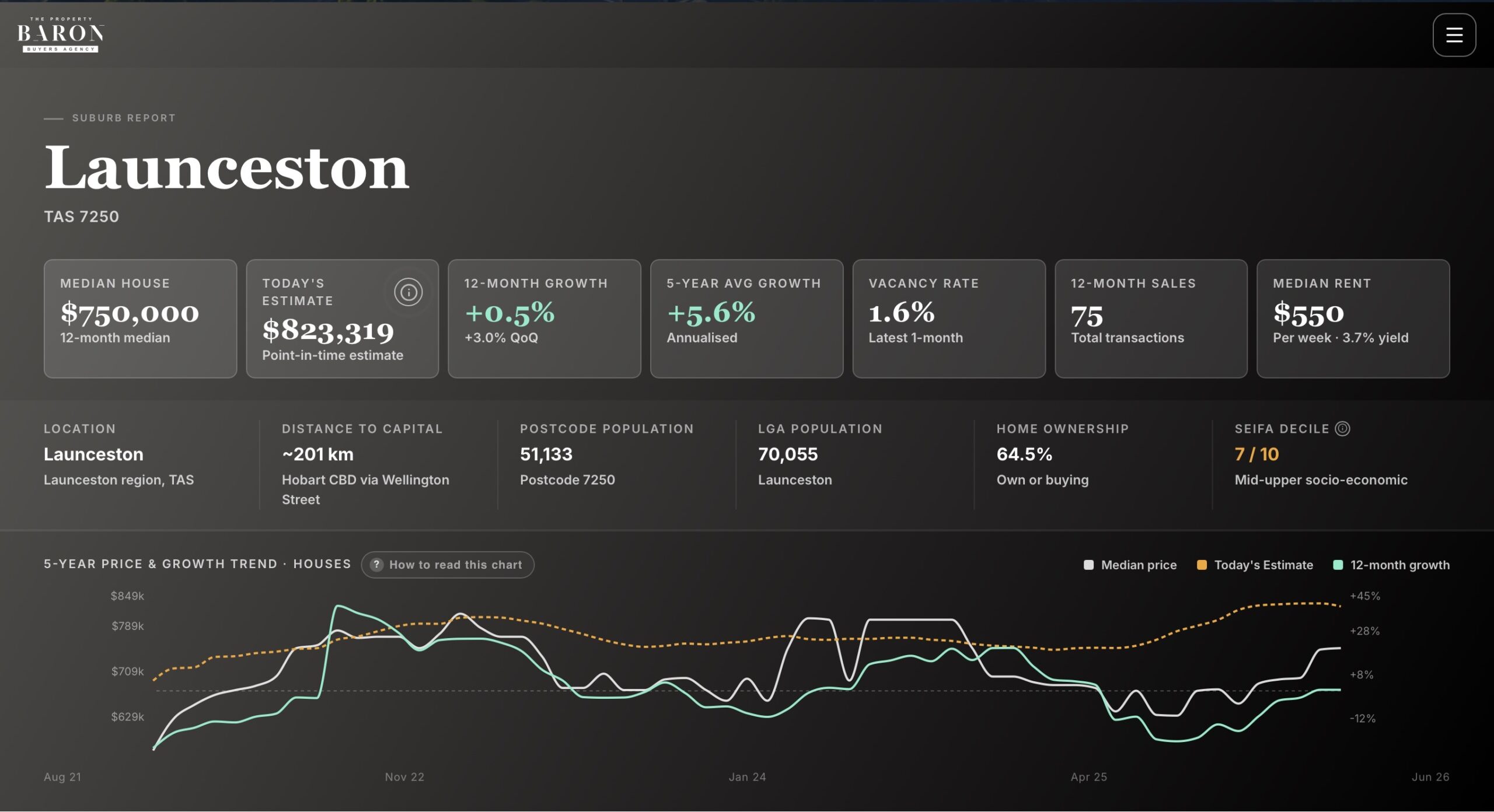
Current Market Snapshot
- Median House Price: $750,000
- 12-Month Growth: 0.5%
- Average Annual Growth (5 Years): +5.6% p.a.
- Rental Vacancy Rate: 1.6% (houses), 1.69% (units)
- Median Rental Yield: 3.7%
- Median Days on Market: 37 days (houses), 72 days (units)
- Annual House Sales: 75 Sold
Source: PropTrack, 2025
Launceston vs Other Comparable Regional Markets
Many buyers and investors comparing regional Tasmanian options will also consider:
- Hobart the state capital, at a meaningfully higher median price point,
- Devonport the Spirit of Tasmania port city, benefiting from port redevelopment and lower entry prices,
- and Burnie, a northern industrial and commercial centre with strong yield characteristics.
Launceston stands apart from these alternatives due to its:
- status as Tasmania’s second city and northern capital, offering a depth of amenity, employment diversity, and cultural infrastructure that Devonport and Burnie cannot match,
- $722.5 million committed health infrastructure pipeline, anchored by the Launceston General Hospital Precinct Masterplan and Northern Heart Centre,
- Thermometer Score trajectory, up from 34 to 53 over the past 12 months, the strongest directional signal in the current data even though price growth remains muted,
- and an affordability position, median $750,000 for houses, $490,000 for units, that keeps it accessible relative to comparable mainland regional cities.
Key Takeaways
- Hotspotting’s official Suburb Report classifies the Launceston house market as Plateau, a quiet, sales-volume-flat market with 12-month growth of just +0.5%, but healthy 5-year average growth of +5.6%
- The Thermometer Score sits at 53/100 (Neutral), but has climbed from 34 to 53 over the past 12 months, a meaningful build in underlying market pressure
- Median house price is $750,000; median unit price is $490,000
- Rental vacancy is tight at 1.6% (houses) / 1.69% (units), with yields of 3.7% and 4.34% respectively
- Days on market sit at a moderate 37 days for houses (72 days for units), with 44.9% of sales achieving above asking price
- The unit market’s -18.92% 12-month figure reflects recent volatility on thin volume (31 sales/year) rather than a settled trend
- A $722.5 million health infrastructure pipeline the Launceston General Hospital Precinct Masterplan and Northern Heart Centre is committed to the region
- Only 5 of 54 scorable markets (9.3%) across the broader Launceston LGA currently carry a positive PPI classification; Launceston’s houses sit below the LGA average Thermometer Score of 64.6
- Suburb selection matters, East Launceston, Trevallyn, South Launceston, West Launceston and Prospect each carry meaningfully different price points and momentum to the 7250 postcode aggregate
- Data varies across sources and snapshot dates; buyers should verify current suburb-level figures with a local agent before transacting
Final Thoughts from a Local Buyers Agent
Launceston today is not a market chasing headlines and the data is honest about that. Hotspotting’s own read is unambiguous: this is a “quiet holding pattern,” with sales volumes flat and price growth essentially at a standstill over the past year. For buyers looking for the next fast-moving growth corridor, that’s a fair signal to pump the brakes on expectations.
But look one layer deeper and there’s a more interesting story. The Thermometer Score’s climb from 34 to 53 over twelve months is a genuine build in market pressure, vacancy is tight, turnover is moderate, and close to half of all sales are achieving asking price or better. That’s the profile of a market quietly firming beneath the surface, even while headline growth hasn’t caught up. Layer on a $722.5 million committed hospital infrastructure pipeline, an already-dominant health and social assistance employment base, and house prices that remain meaningfully more affordable than comparable mainland regional cities, and Launceston presents as a market worth holding and worth watching rather than one to chase on hype.
The combination of:
- an honest, data-led Plateau classification rather than an overstated growth narrative,
- a Thermometer trajectory building steadily from 34 to 53 over the past year,
- a committed $722.5 million health infrastructure pipeline anchoring long-term economic confidence,
- and an affordability position that keeps Launceston accessible relative to mainland alternatives,
makes Launceston a market that rewards patient, well-informed buyers, those prepared to look past the flat headline number and understand what’s actually building underneath it.
At The Property Baron, we help buyers identify opportunities, access off-market properties, and negotiate strategically. Thinking of buying in Launceston or northern Tasmania? Book a discovery call with our local team